


-

- Agronomy
- Tar Spot In Corn: How To Help Prevent Yield Loss
.jpg?ext=.jpg)
If you grow corn, tar spot has either crossed your mind or already caused you some trouble in the field. This destructive disease is still relatively new with the first incidence reported in 2015 and new regions infected each year since.
What’s the big deal about tar spot? Growers who’ve battled it have seen losses of 20-60 bushels per acre.1 It’s much more aggressive than typical diseases of the Corn Belt, like gray leaf spot or northern corn leaf blight. Tar spot develops rapidly, overwinters in residue and can travel airborne from neighboring fields, making it nearly impossible to eradicate completely.
Here’s what you need to know.
Tar Spot Symptoms
The first thing you need to know is how to quickly identify this disease. So, what does tar spot look like in the field?
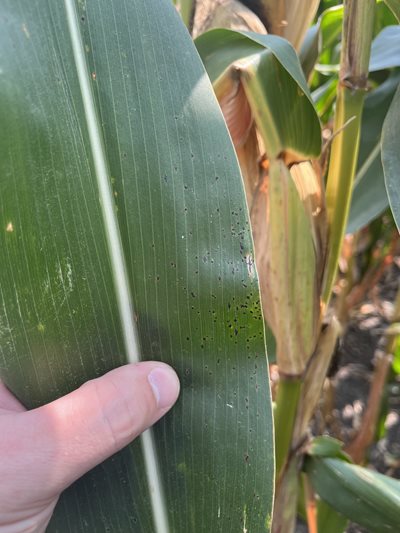
Think about dipping a paintbrush in a can of black paint and then splattering it onto a corn leaf. That’s what tar spot looks like. The black “paint” flecks are stomata that embedded in the plant leaf. Unlike insect frass, which can look similar, the stomata cannot be rubbed off. Tar spot also causes some yellowing on the leaves and stalks.
Once a plant is infected, it takes about 17 days for visible signs to appear.2 Symptoms can pop up at any point during the growing season but typically are most severe in late summer.
Tar Spot Development
Like any plant disease, tar spot requires all elements of the disease triangle to form: a host, a pathogen and a conducive environment.
If you have corn in your field, you can check “host” off the list. The pathogen can blow in from other areas or overwinter on residue if you’ve had an infection before.
A conducive tar spot environment includes:
- Moderate temperatures between 60-80 degrees.
- Very high humidity, greater than 85%.
- Leaf wetness for more than seven hours per day.
These conditions are especially common in the eastern Corn Belt with the moderate temperatures and high humidity the Great Lakes provide.
Signs of the disease typically are observed around pollination, but it’s been known to pop up sooner, especially if you are experiencing a lot of foggy mornings with more moisture. In past seasons, we have seen it creep in around the end of June into early July, continuing to get worse as the season went on. That’s why it’s important to scout early and often. Tar spot symptoms can change dramatically in just five to seven days.
Tar Spot Management
Again, tar spot is not your average corn disease. Making a single fungicide application likely won’t cut it if you have pressure.
Typically, making two sequential applications is a strong strategy although optimal timing may vary. A study by the University of Minnesota found the best approach to be an application at V8 followed by a second application three weeks later, which resulted in an 18-31% yield increase.1
Past research shows a 20 bu/A yield advantage when an R1 fungicide application was followed by a late R4 or early R5 application in irrigated corn with heavy tar spot pressure, compared to a single R1 application.3 Work with your CROPLAN® local retail seed expert to determine the best timing for your operation.
Applying a pre-tassel fungicide can offer plant health benefits and extend the window of disease protection. Strobilurin and SDHI chemistries are preventive fungicides that effectively kill germinating fungal spores and offer plant health benefits. Products with these active ingredients may be a good option for a first-pass fungicide application, and then disease protection can be extended with a second pass at the R1 or R2 growth stage.
Since the pathogen overwinters, simply burying residue won’t prevent it from returning. If tar spot was present the previous year, planting corn again that next year is not advised because you’re essentially planting into the disease.
Tar spot is a tricky disease to manage but early action is key. Your CROPLAN local retail seed expert is here to help you plan for and manage the pathogen.
1Bongard, P. "Strategic Farming: Let's talk crops focused on tar spot of corn." University of Minnesota Extension. March 13, 2023. https://blog-crop-news.extension.umn.edu/2023/03/strategic-farming-lets-talk-crops_13.html.
2Solorzano, J. E., et. al. " Tar Spot of Corn: A Diagnostic and Methods Guide." Plant Health Progress 24, no. 1 (2023): 117-122. https://apsjournals.apsnet.org/doi/10.1094/PHP-04-22-0033-DG.
3WinField United, Roth, 2019.
© 2026 WinField United. Important: Before use always read and follow label instructions. Crop performance is dependent on several factors many of which are beyond the control of WinField United, including without limitation, soil type, pest pressures, agronomic practices and weather conditions. Growers are encouraged to consider data from multiple locations, over multiple years and to be mindful of how such agronomic conditions could impact results. CROPLAN is a trademark of WinField United.
ENOUGH ALREADY, I’M READY FOR RESULTS.
Tired of the same old, same old? Looking for a partner this season and not just another buddy? Find your local CROPLAN retailer, and show those acres who’s boss.
RELATED INSIGHTS
Managing Southern Rust in Corn
Last season, southern rust was easy to find in cornfields across much of the Midwest. Unfortunately for farmers, all the elements of the disease trian...
READ MORE ❱
Maximize Corn Yield Potential & Minimize Stress with Post-emergence Weed Control
As a corn grower, you know the vital role every stage of your crop’s development plays in determining yield potential. However, even with optima...
READ MORE ❱
5 Ways To Optimize Soybean Yield Potential
When growing soybeans, there’s a balance you need to strike between pushing for optimal yield potential and ensuring profitability. From plant...
READ MORE ❱