



-

- Agronomy
- Make Stronger Input Decisions by Thinking Long-Term
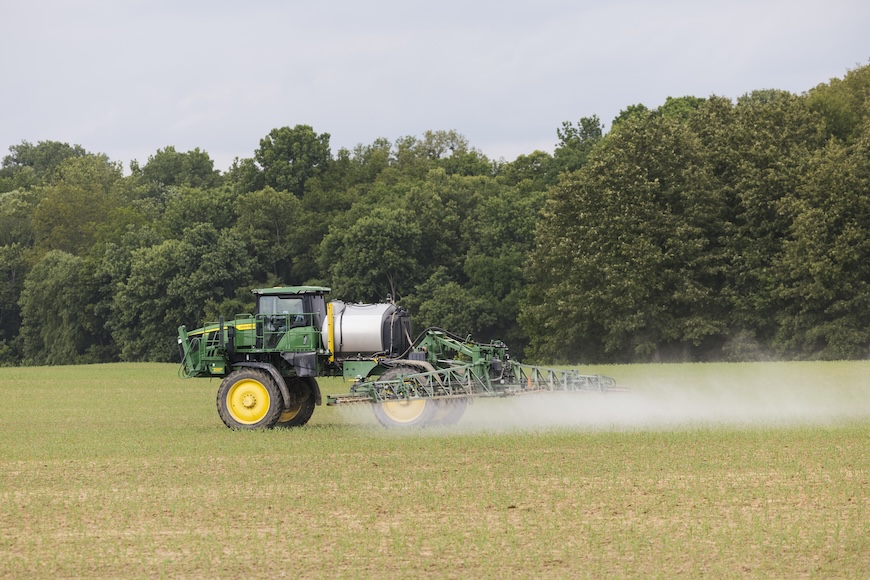
Before you slash your budget, consider these agronomist recommendations to maximize ROI potential while setting yourself up for future success.
Don’t Skimp on Weed Control and Fertility
When it comes to inputs, weed control and fertility are must-haves in order to get the most from your acres. Trying to reduce rates or cut herbicide or fertilizer applications not only means limitations for this year’s crops, but also trouble for future crops. Weeds that aren’t controlled spread seed in the soil, adding more weed pressure and management costs down the road.
There are several steps you can take to optimize your fertility investment without breaking the bank.
1. Soil sample and tissue sample: Sampling gives you a baseline for the nutrient levels in your soil and plants so that you can build a fertilization program that delivers only what plants need to maximize their potential.
2. Add nitrogen stabilizers: Whether you apply nitrogen in the spring or fall, adding a stabilizer can help ensure that nitrogen remains available in the root zone. Identifying where your risk of nitrogen loss is and incorporating a nitrogen stabilizer to your management plan to minimize that risk can help ensure plants have what they need to maximize yield potential.
3. Know your seeds’ response-to-nitrogen scores: One way to allocate your fertility dollars is by planning applications based on how your hybrids respond to nitrogen applications. 2025 Answer Plot® data shows hybrids’ average response to nitrogen is 68.7 bu/A, depending on the hybrid.1 Some hybrids are ear size-driven, meaning they benefit from early nitrogen management, while others are kernel weight-driven and benefit from late-season nitrogen management. Response-to-nitrogen scores, along with genetic cues for timing, can help you dial in on a more efficient nitrogen program. With today’s high input costs, knowing where to place your spend on inputs to make the biggest impact is critical. You can lean on your local CROPLAN® retail seed expert to answer any questions and help you optimize your nitrogen management plan accordingly.
Manage Fungicide Applications on a Case-by-Case Basis
Fungicide management isn’t as cut and dry as weed control and fertility. My recommendation is to review response-to-fungicide scores for the hybrids you’ve chosen. For those that show a high response, plan to apply a fungicide. With the widespread disease pressure we saw in 2025, chances are the same pressures will return this season. In that case, a fungicide application will pay off most for your hybrids with high response-to fungicide scores.
Even in the absence of disease, those hybrids with a high response to fungicides are more likely to receive plant health benefits that can help improve yield potential. On the other hand, for hybrids with low response-to-fungicide scores or on acres with historically lower productivity, I’d consider taking a “wait and see” approach. Watch the weather conditions and scout fields to decide if a fungicide application makes economic sense.
Fine-Tune Decisions to Increase Cost Efficiency
The real key to optimizing input budget and placement is by looking at decisions on an acre-by-acre basis. Of course, opting for a blanket management approach that covers your whole operation is easier, but often, less profitable.
Using prescription services can help shift from an input-cost-per-acre mentality to an input-cost-per-bushel mindset. For example, the WinField® United Advanced Acre® Rx (AARx) Program provides custom recommendations that are built based on over 6 million data points. These prescriptions aim to support increased ROI potential for input expenses, resulting in an average ROI boost of $36 per acre in corn and $4.50 per acre in soybeans, respectively.2
For more information about the AARx program or to discuss opportunities to maximize early-season input decisions, be sure to reach out to your CROPLAN local retail seed expert.
12025 Answer Plot. Difference between non-limited and limited N application over a 14 year period. Rates varied by soil type and location.
2Yield increases from 2023 Advanced Acre Rx enrolled acres. The 2024 grower point of sale data was used to calculate average spend on required products to derive the ROI.
All photos are either the property of WinField United or used with permission.
© 2026 WinField United. Important: Before use always read and follow label instructions. Crop performance is dependent on several factors many of which are beyond the control of WinField United, including without limitation, soil type, pest pressures, agronomic practices and weather conditions. Growers are encouraged to consider data from multiple locations, over multiple years and to be mindful of how such agronomic conditions could impact results. Advanced Acre, Answer Plot, CROPLAN and WinField are trademarks of WinField United. All other trademarks are the property of their respective owners.
ENOUGH ALREADY, I’M READY FOR RESULTS.
Tired of the same old, same old? Looking for a partner this season and not just another buddy? Find your local CROPLAN retailer, and show those acres who’s boss.
RELATED INSIGHTS
Get More From Your Seed Investment With The Elite Rx® Program
As much as we love seed, we know it’s only one variable in the complex equation it takes to run a profitable operation year in and year out. Our...
READ MORE ❱

5 Ways to Maximize Enlist E3® Soybeans
Soybean genetics and traits have come a long way in recent years. Since its launch in 2019, the Enlist E3 trait has risen in popularity, becoming one ...
READ MORE ❱

Agronomic Insights from the Innovation Center
Every year, the WinField® United Innovation Center transforms massive amounts of agronomic data into practical, ROI-driven strategies for farmers....
READ MORE ❱